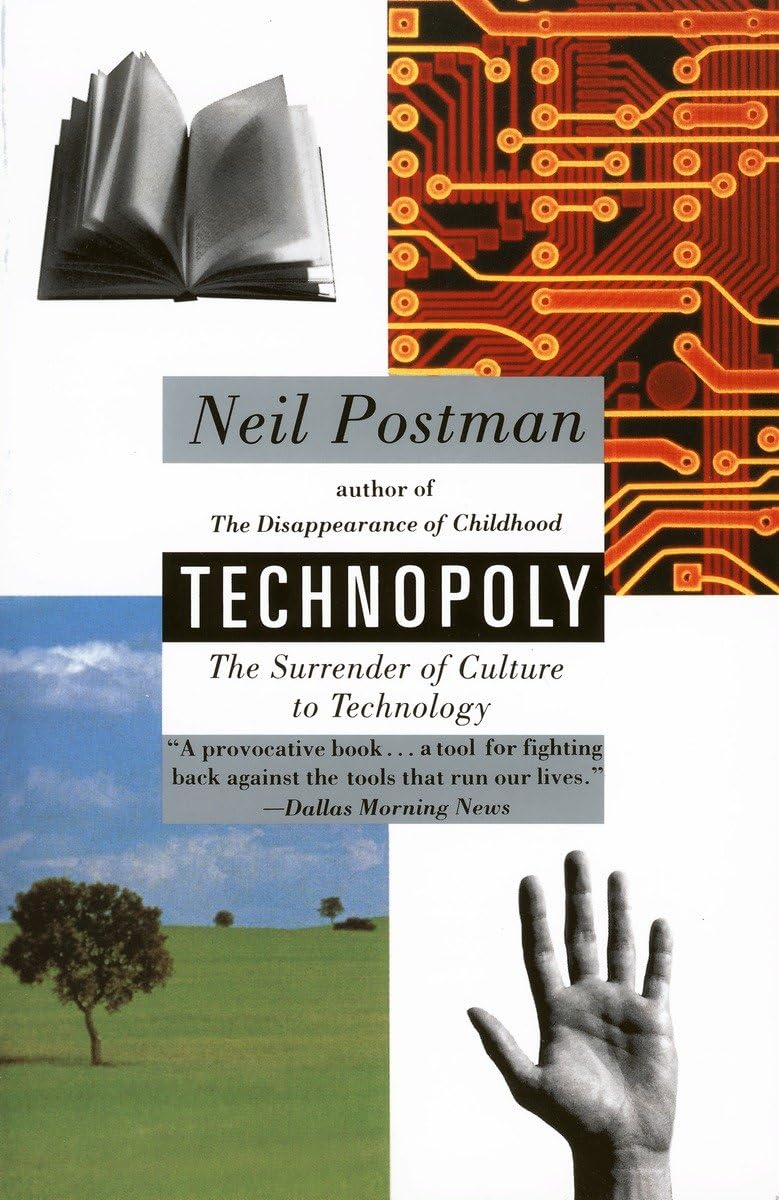
Technopoly
Neil Postman
Once a technology is admitted, it plays out its hand; it does what it is designed to do.
New technologies change what we mean by "knowing" and "truth"; they alter those deeply embedded habits of thought which give to a culture its sense of what the world is like — a sense of what is the natural order of things, of what is reasonable, of what is necessary, of what is inevitable, of what is real.
What the monks did not foresee was that the clock is a means not merely of keeping track of the hours but also of synchronizing and controlling the actions of men.
The unreal knowledge acquired through the written word eventually became the pre-eminent form of knowledge valued by the schools. There is no reason to suppose that such a form of knowledge must always remain so highly valued.
New technologies alter the structure of our interests: the things we think about. They alter the character of our symbols: the things we think with.
The average person today is about as credulous as was the average person in the Middle Ages. In the Middle Ages, people believed in the authority of their religion, no matter what. Today, we believe in the authority of our science, no matter what.
The world we live in is very nearly incomprehensible to most of us. There is almost no fact, whether actual or imaginary, that will surprise us for very long, since we have no comprehensive and consistent picture of the world.
Technopoly is a state of culture. It is also a state of mind. It consists in the deification of technology, which means that the culture seeks its authorization in technology, finds its satisfaction in technology, and takes its orders from technology. [...] Technopoly flourishes when the defenses against information break down.
[Technopoly] is what happens when institutional life becomes inadequate to cope with too much information. It is what happens when a culture, overcome by information generated by technology, tries to employ technology itself as a means of providing clear direction and humane purpose.
Social institutions are concerned with the meaning of information and can be quite rigorous in enforcing standards of admission.
All theories are oversimplifications, or at least lead to oversimplification. The rule of law is an oversimplification. A curriculum is an oversimplification. So is a family's conception of a child. That is the function of theories—to oversimplify, and thus to assist believers in organizing, weighting, and excluding information. Therein lies the power of theories. Their weakness is that precisely because they oversimplify, they are vulnerable to attack by new information. When there is too much information to sustain any theory, information becomes essentially meaningless.
The expert in Technopoly has two characteristics that distinguish him or her from experts of the past. First, Technopoly's experts tend to be ignorant about any matter not directly related to their specialized area. The average psychotherapist, for example, barely has even superficial knowledge of literature, philosophy, social history, art, religion, and biology, and is not expected to have such knowledge. Second, like bureaucracy itself (with which an expert may or may not be connected), Technopoly's experts claim dominion not only over technical matters but also over social, psychological, and moral affairs. In the United States, we have experts in how to raise children, how to educate them, how to be lovable, how to make love, how to influence people, how to make friends.
When it comes to machinery, what Technopoly insists upon most is accuracy. The idea embedded in the machine is largely ignored, no matter how peculiar.
If we define ideology as a set of assumptions of which we are barely conscious but which nonetheless directs our efforts to give shape and coherence to the world, then our most powerful ideological instrument is the technology of language itself. Language is pure ideology. It instructs us not only in the names of things but, more important, in what things can be named. It divides the world into subjects and objects. It denotes what events shall be regarded as processes, and what events, things. It instructs us about time, space, and number, and forms our ideas of how we stand in relation to nature and to each other.
To reason in Japanese is apparently not the same thing as to reason in English or Italian or German.
When a method of doing things becomes so deeply associated with an institution that we no longer know which came first—the method or the institution—then it is difficult to change the institution or even to imagine alternative methods for achieving its purposes